
This is a new format where we’ll share some of the most interesting insights we’re discovering across WOOF classrooms throughout the school year.
One of the strongest patterns we’re seeing is simple:
Schools that WOOF systematically improve wellbeing over time.
That’s not just encouraging—it’s exactly why WOOF exists.
As an impact startup, we’re obsessed with measuring whether we’re actually creating positive change. Impact isn’t a marketing claim; it’s something that must be demonstrated through data.
But measuring impact is more complex than simply observing improvement.
To understand whether an intervention works, you have to compare actual development against the development you would have expected to see without it.
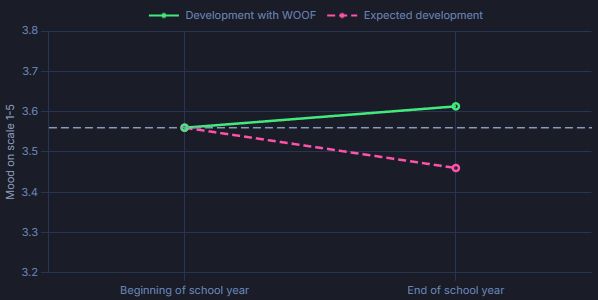
In the graph below, the red dotted line represents the expected baseline development of classroom wellbeing. The green line represents the actual development observed in WOOF classrooms.
The true impact is the difference between the two.
This approach to impact measurement is something we learned during the Nordic Impact Startup Accelerator in Oslo, where WOOF was selected as one of ten impact startups from across the Nordic region.
The reality is that demonstrating genuine impact is hard.
It requires:
• A robust data foundation
• Consistent measurement over time
• Disciplined analysis
• A large and growing dataset
Most startups never reach the point where they can confidently separate correlation from impact. Although they might have it.
We’re proud that we’re beginning to see these patterns emerge.
And we’re even more excited about what’s ahead.
As more schools and classrooms join WOOF, our ability to understand the pathways to wellbeing, belonging, and thriving classrooms continues to grow.
This is just the beginning of what educational intelligence can reveal.