
Every classroom is different, and treating them as if they are the same should be a thing of the past.
Every teacher knows it: no two classrooms are alike. Same subject, same age group, same curriculum, and still, 8B can feel completely different from 8A.
Put 24 students in a room and something happens between them. A collective dynamic emerges: a particular energy, social rhythm and way of responding to learning. Teachers pick up on it almost instinctively. Walk into a new class and, within minutes, you are already thinking: What does this class need today?
And sometimes a new class feels strangely familiar. The energy, the way they respond to group work, the way silence lands in the room; you’ve seen something like it before, and you have a good idea of what might work.
The class is more than the sum of its students
Education has rightly focused heavily on the individual student. Every student has their own needs, pace and way of learning. That focus matters. But there is another level that can easily disappear from view: the class itself.
A classroom is not simply 24 individual students learning alongside each other. Their interactions create a collective environment that shapes how learning happens.
The classroom is an important unit of analysis that has historically been difficult to see.
What we’re seeing in the data
Across the classes checking in regularly with WOOF, recurring patterns are emerging. Classes appear to have something like a collective classroom signature: an atmosphere, energy level and social orientation that can persist beyond the fluctuations of a single day.
These signatures are not fixed. Classes can move, develop and change over time. Yet they are relatively stable, and can show interesting durable patterns: a consistent tendency in dynamics.
In our data, we see recurring classroom archetypes with different combinations of energy and social orientation. Different things appear to influence their mood, and different classes seem to show different preferences and motivational drivers.
The important point is not to put classes into boxes. It is to recognize that different classrooms can require different conditions to grow, and that understanding the collective pattern may help us think differently about what to do next.
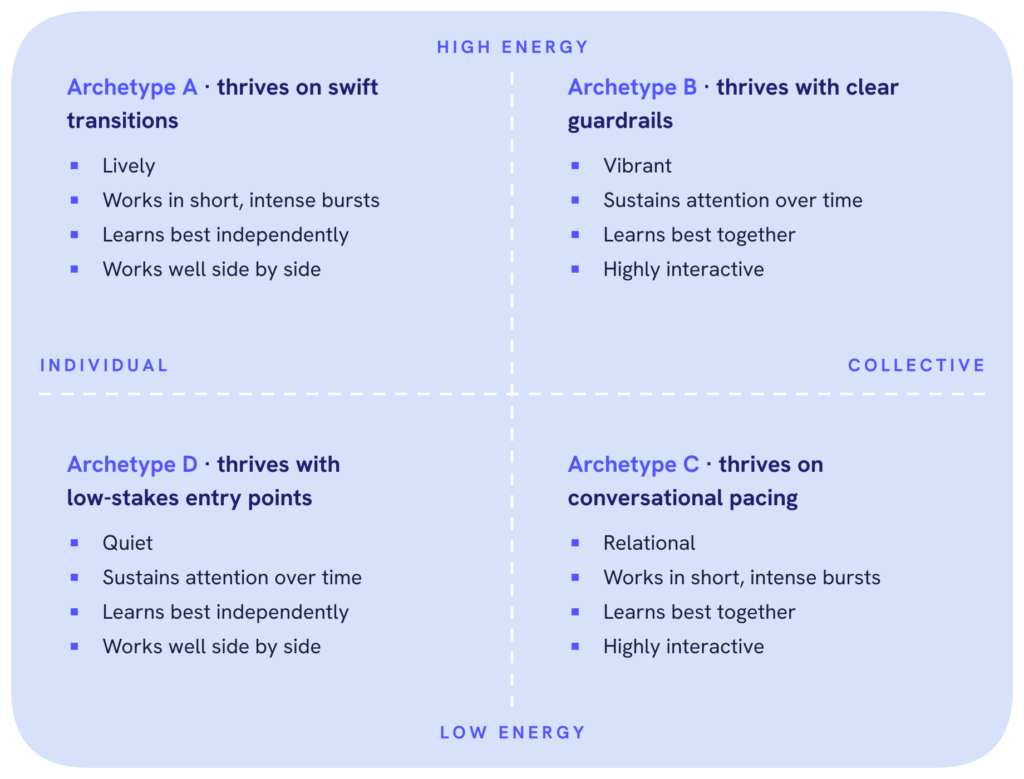
Figure: Four classroom archetypes. Each archetype combines two dimensions: how much energy a class brings, and whether it leans toward working individually or together. An archetype describes how a class is right now, based on its recent check-ins. It is not a fixed label, and no archetype is better than another. The point is not to put classes into boxes, but to recognize that different classes need different conditions to grow.
What this means for the classroom
A class is rarely just “doing well” or “doing badly”. Understanding its archetype changes concrete choices: group work versus individual work, pacing, how much structure to hold, how transitions are run, and which social activities are worth the time. Very experienced teachers sense the class and what it needs quickly, and have the experience to adjust.
The faster all teachers can understand their class and its archetype, the faster they figure out how to get it to a place ready to engage in learning.
What this means for the school
Understanding the composition of your classrooms opens up an exciting question for leadership: what would it look like if our structures, expectations and support were designed for the full diversity of our classrooms?
Training, schedules, pedagogical expectations, support allocation and implementation approaches all carry the imprint of assumptions about what a “typical” classroom looks like, usually without anyone intending it, and often invisible until classrooms are seen clearly, one by one.
Once we can recognize the patterns that recur across classrooms, we can start to see where the biggest opportunities are and where a small shift in support could have an outsized effect.