
How one school district turned a single-school pilot into shared infrastructure for classroom wellbeing, and what changed once every school could see the same data.
During the 2024/25 school year, WOOF was introduced in a small number of schools within a larger school district. The goal was to test whether continuous classroom intelligence, real-time mood data paired with targeted interventions, could strengthen student growth and improve learning environments.
The results were promising enough that the district made a bigger call. For 2025/26, WOOF became the district’s shared infrastructure across all of its schools, the common layer every classroom used to understand and improve its own conditions.
What Changed Across 110 Classrooms
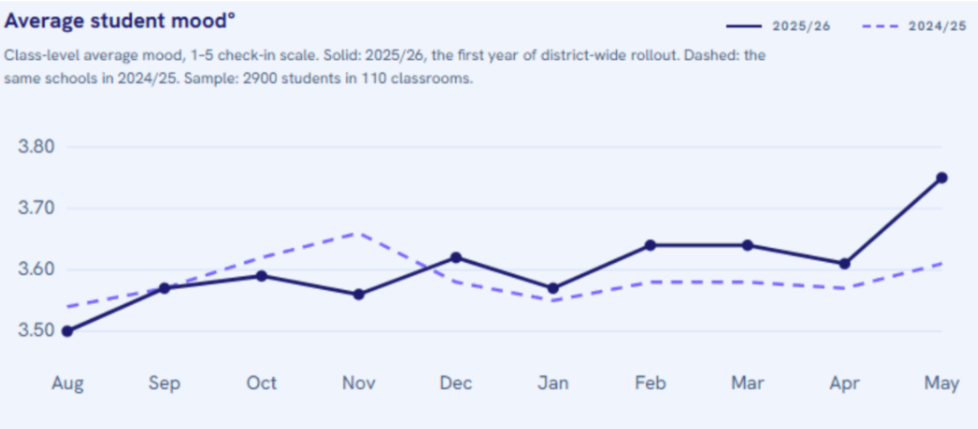
The data from that first full district-wide year shows a clear shift. Across a sample of 2,900 students in 110 classrooms, average student mood, measured on a 1 to 5 check-in scale, rose from 3.50 in August to 3.75 by May. The same schools the year before, prior to the district-wide rollout, held closer to flat, opening at 3.54 and closing at 3.61.
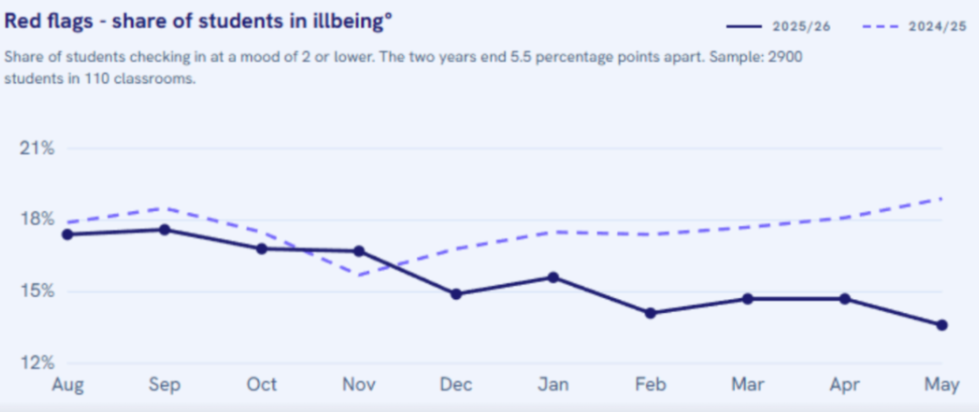
Red flags, students checking in with a mood of 2 or lower, told the same story in reverse. In the rollout year, that share fell from around 17% in the autumn to roughly 13.5% by May. The year before, the same measure moved the other way, closing near 19%. By the end of the school year, the two years sat 5.5 percentage points apart.
Real Students, Not Just a Chart
Behind each percentage point is a student who was flagged as struggling in one year’s data and was not in the next, or a classroom where a teacher caught a low mood early enough to do something about it.
What It Means for Other Districts
The case points to something important about how educational improvement happens. Meaningful change rarely comes from a single initiative. It comes when schools develop the ability to continuously understand classroom dynamics, identify emerging challenges early, and act systematically.
When an entire district shares a common infrastructure for educational intelligence, schools no longer improve in isolation. Every classroom contributes signals, every intervention contributes evidence, and successful approaches can be identified, shared, and replicated. Patterns become visible. The network learns, and the district becomes steadily more capable of creating the conditions in which students flourish.
Because improving classroom conditions is not only about measuring what is happening. It is about building the intelligence required to change what happens next.