
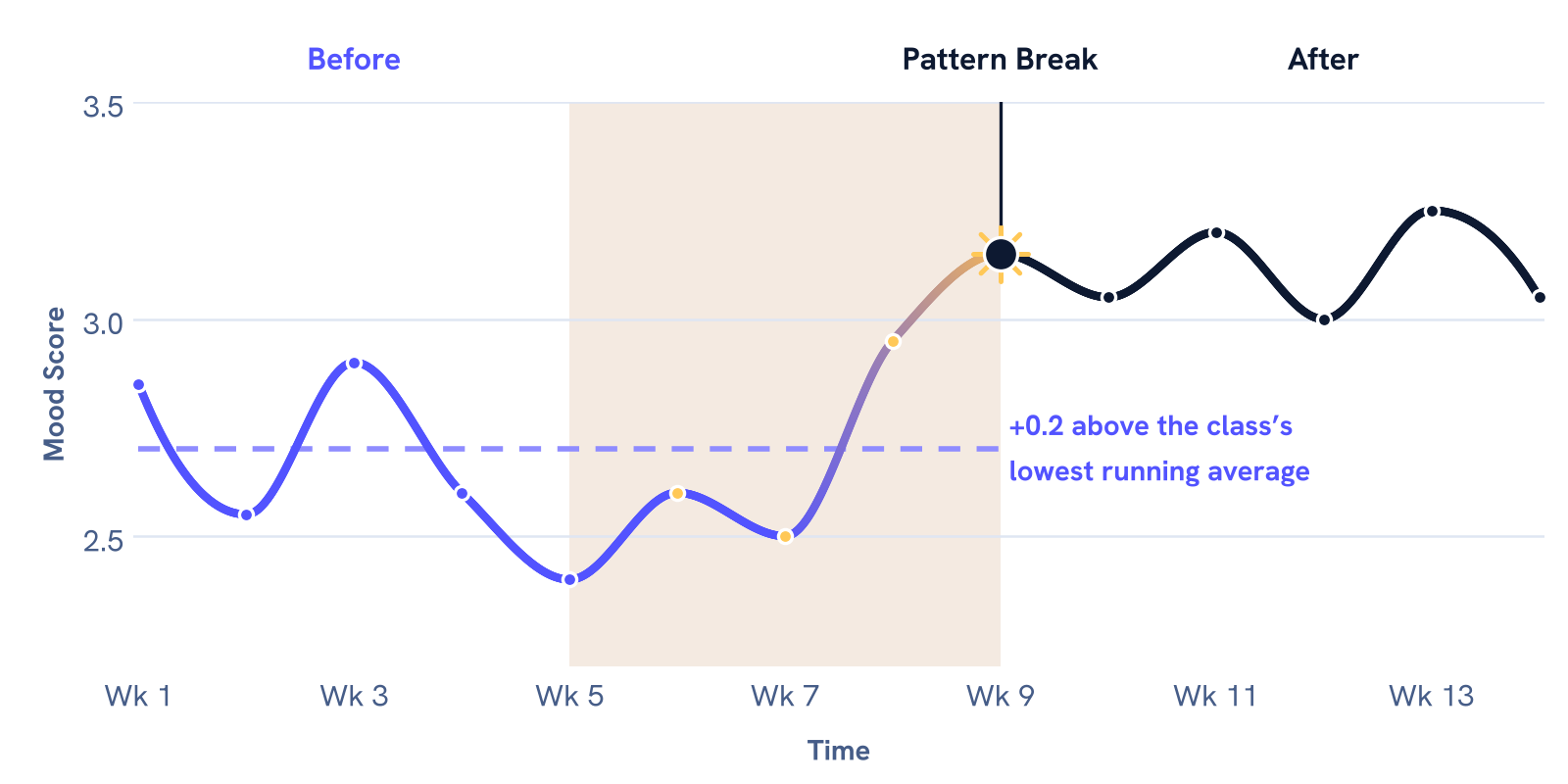
All teachers know: classroom development takes time. When a dominant undesirable classroom culture has taken root it is a marathon to change. Looking across thousands of classrooms over time, we found an early signal of positive development to turn the marathon into sprints. We call it a Pattern Break: a measurable moment where a classroom moves out of a negative wellbeing pattern and into a more positive one.
It’s an example of the real-time, continuous signals: A Pattern Break doesn’t wait for a term to end or a report to be written. It shows up within weeks, while a teacher can still ask the class: how does this change feel, and what did we do that brought it about?
In 2025/26, we recorded 30,918 of them.
But a Pattern Break isn’t just a short-term wobble in the data. Looking across classes over a full year, we see a statistically significant correlation between a class experiencing a Pattern Break and stronger mood outcomes over the longer term. That doesn’t prove one causes the other, but it’s a strong signal that a Pattern Break isn’t only a momentary shift. It may be an early marker of a class moving onto a better trajectory.
That’s what makes it useful at this layer. It gives a teacher who has been trying something for weeks a signal that it’s working, long before the annual numbers would tell them either way.
[INSERT IMAGE: figure-06-pattern-break.png]Figure 06: What a Pattern Break looks like. A Pattern Break is the moment a class leaves a low wellbeing pattern behind and settles into a better one. Here, a class’s weekly mood hovers around a threshold (0.2 points above its lowest running average) and dips. Then it rises above the threshold for two check-ins in a row, and stays there. For the teacher, this is an early sign that something is working, visible within weeks instead of at the end of the year.
Validated Impact
Pattern Breaks have made something intangible concrete and countable. We’re working with researchers at the University of Chicago to see how these fast signals relate to the slower outcomes schools already track, like attendance and test scores. That work is ongoing.
Going a step further, the independent analysts at Valuing Impact translated these Pattern Breaks into estimated societal value. Their model estimates that WOOF generated €35 million in societal impact last year.
This matters beyond any classroom or school: investing in how children grow and learn should not be looked upon as a soft cost, but one of the most consequential investments a society can make. The PISA results clearly highlight the macro-level of this and now the budgets are starting to follow.