
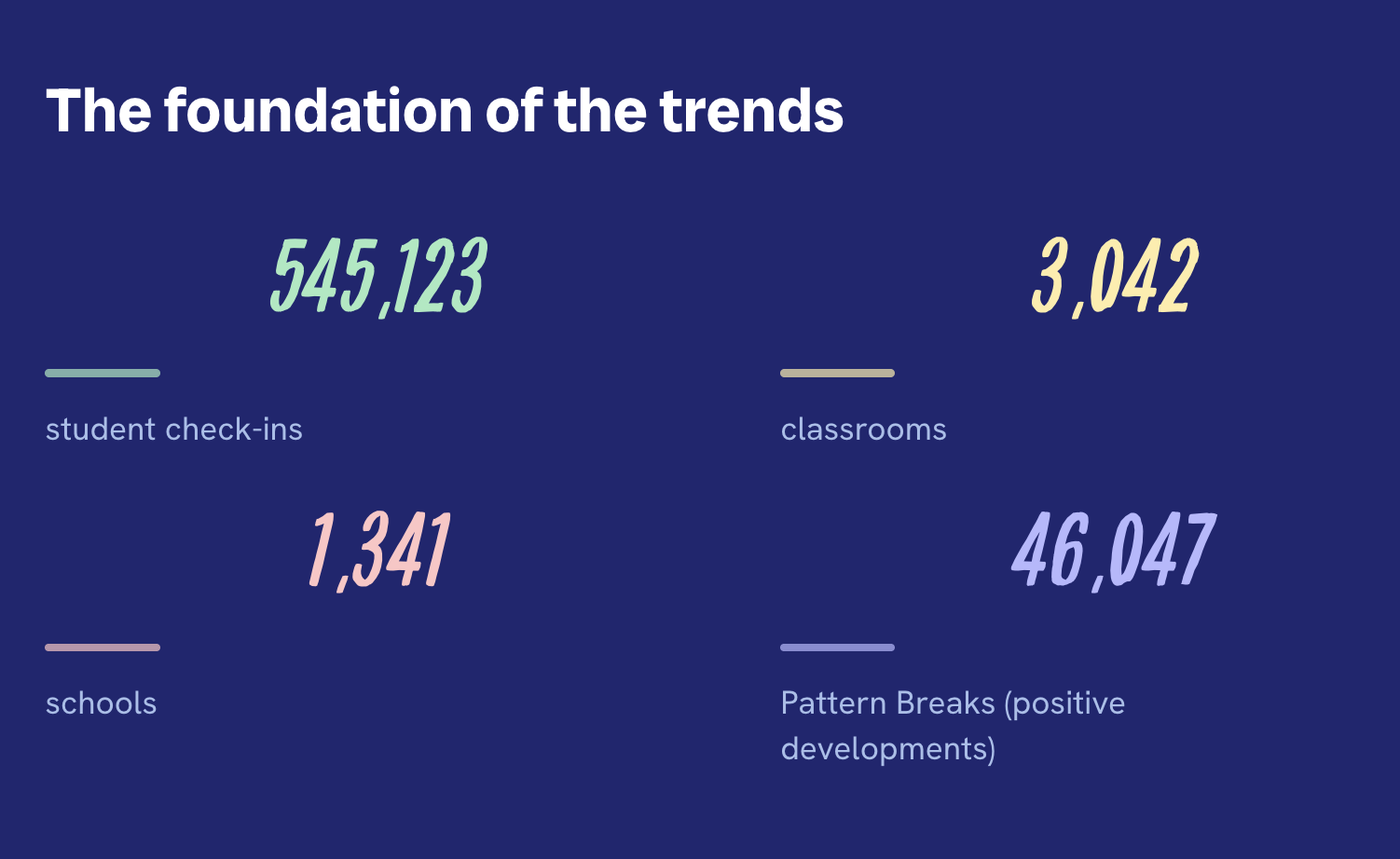
The Foundation of the Trends
This publication draws on anonymous check-ins from 3,042 classes in 1,341 schools as well as conversations with students, teachers, school leaders and educational professionals.
Every insight in this publication is grounded in two things: the continuous stream of data generated by students through anonymous micro check-ins, WOOFs, and the ongoing conversations we have with the district and municipality leaders, school leaders, educators, and students who use WOOF every day.
Together, they form a growing educational network, one built not on a single annual survey, but on real signals from real classroom interactions, paired with a constant feedback loop from the people living those classrooms day to day. The check-in data tells us what is happening inside a classroom. Our conversations with schools tell us why, and what to do about it.
During the 2025/26 school year, students completed 328,432 anonymous micro check-ins and evidence-based activities across Northern Europe, Australia, and 34 U.S. states. This represents a 253% increase in student engagement compared with the previous school year, meaning an increase in the compound intelligence of the network’s effects.
A unique set of data
When classes check-in with WOOF they complete regular micro check-ins, typically several times a week. Based on these check-ins we gain a unique longitudinal dataset of how classes develop over time. We notice patterns in what seems to influence classes at different grade levels, how classes use the different features in WOOF, and how classes seem to have different characteristics that shape their response to different stimuli and their development over time.
When many classes at a school use WOOF, a second layer of patterns emerges: differences in how schools implement WOOF, and patterns in mood and key impact factors that vary in some ways, but hold steady in others across schools and networks.
Together, this gives us a clearer picture of what tends to work and why at both the classroom and school level.
In WOOF’s Classroom Learning Trends 2025/2026, we share some of the most important findings with you.